
One offer, two winners: 29% more spend at the retailer, 31% more across the network
.webp)
Measured incremental results from a live campaign with aleading national retailer on the PokitPal platform.
Three months into the campaign, users who became eligible for the retailer's offer spent 29% more with that retailer than users who did not, and 31% more across the rest of the network.
The challenge
Offers are easy to run and hard to prove. The commercial question for any retailer or media network is not whether spend occurred, but whether the offer caused spend that would not otherwise have happened.
This campaign was designed to answer that question directly. Rather than reporting redemption volume or attributed sales, PokitPal set out to isolate the offer's true incremental effect: the behaviour change attributable to the offer itself, measured against what comparable users did without it.
The PokitPal approach
PokitPal operates a card-linked offer network. Offers from participating merchants are surfaced to users through participating publishers,and because the offer is linked to the user's payment card, the resulting spendis observed at the transaction level rather than estimated.
For this campaign, a leading national retailer ran a single offer on the platform. Some users on the network became eligible for that offer. Others did not. Both groups continued to shop as normal, across there tailer and across every other merchant participating in the network.
That structure is what makes the measurement possible. The offer runs as a live commercial campaign, and the network produces the comparison group as a by-product of how eligibility is distributed.
How the impact was measured
PokitPal compared two groups of users
- Eligible users, who became eligible for the retailer's offer
- Non-eligible uers, who did not
Comparing spend and shopping behaviour between these two groups isolates the offer's incremental effect. The difference between the groups is the lift, rather than total spend among people who saw an offer.
A separate cut was used for the network-level result,comparing users who engaged with the offer against those who did not engage. Eligibility and engagement are distinct: eligibility defines who could access the offer, engagement defines who acted on it.
The figures below are drawn from the initial three months of a campaign that is still running.
The results
At the retailer
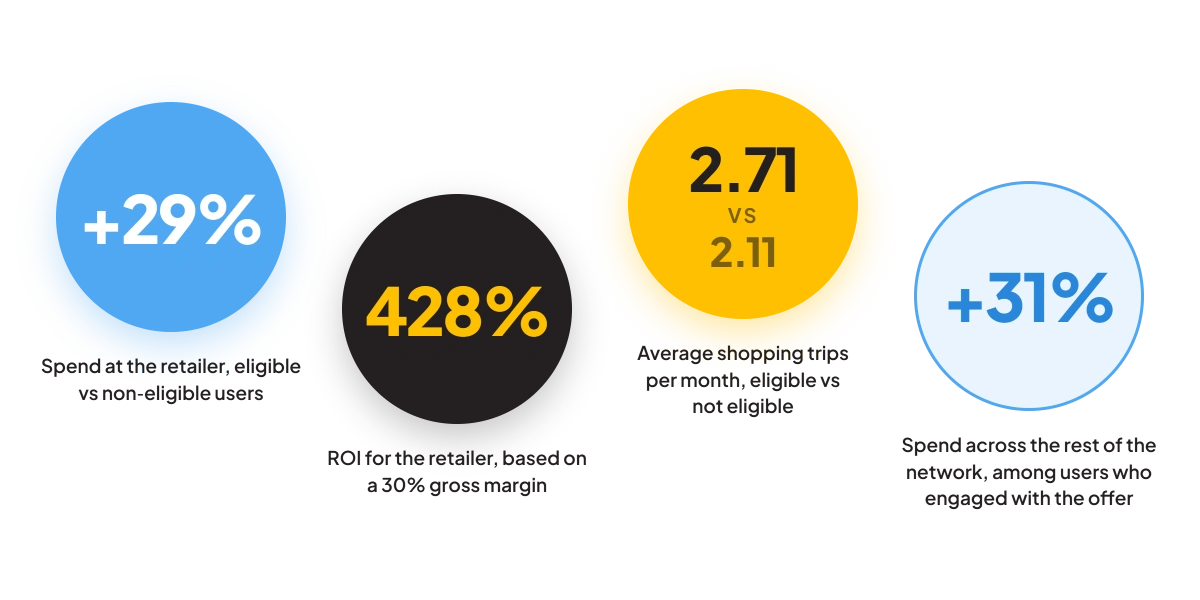
Spend: +29%. Eligible users spent 29% more at the retailer than non-eligible users.
Shopping frequency: 2.71 versus 2.11 trips per month. Eligible users averaged 2.71 shopping trips per month. Non-eligible users averaged 2.11. That is roughly 0.6 of an additional trip per month, per user.
ROI: 428%. Return on investment for the retailer, calculated on a 30% gross margin assumption.
Across the network
Spend at other participating merchants: +31%. Among users who engaged with the offer, spend across the rest of the network rose 31%.
No lift among users who did not engage. The network effect tracks engagement with the offer, not exposure to the platform.
What the data tells us
The composition of the lift matters as much as its size.
The increase came almost entirely from more frequent visits. Basket size stayed virtually flat. That distinction separates two very different commercial outcomes. A lift driven by larger baskets can reflect purchases pulled forward or stockpiling. A lift driven by frequency reflects a change in how often the user chooses that retailer, which is the behaviour retailers are actually trying to buy.
The frequency lift was also growing month over month across the measured period. On that basis, PokitPal expects incremental upside to keep rising as the campaign continues. That is an observation of the trend to date and an expectation, not a result already banked.
Beyond one merchant
The 31% network figure is the part of this campaign that is easy to overlook and hard to replicate else where.
Users who engaged with the retailer's offer did not simply shift spend towards that retailer. They increased spend across other participating merchants as well. One strong, relevant offer raised engagement and relevance across the network, not only for the merchant funding it.
For publishers and media networks, that changes the unit of value. A single well-matched offer improves the performance of the inventory around it. For merchants, it means joining a network where other participants are running strong offers is itself commercially useful.
Business takeaway
Across the initial three months of a live campaign, a single offer on the PokitPal platform produced 29% higher spend at the retailer, 428% ROI on a 30% gross margin assumption, and a frequency-led lift of 2.71 versus 2.11 shopping trips per month, alongside 31% higher spend across therest of the network among users who engaged.
Each of those figures rests on a comparison against users who did not receive or act on the offer. That is the difference between reporting activity and demonstrating incremental behaviour change, measured atthe transaction level.
Run an offer, or join the network
If you are a retailer, brand, publisher or media network weighing what card-linked offers could deliver, we can walk you through the measurement approach behind these numbers and what the model would look like applied to your business.
Let's talk about putting these numbers to work for you.


